Mon–Sat 9AM–7PM IST+91 91960 10784+91 80091 31933contact@intelegalconsultants.in
MeitY Compulsory Registration Scheme · Scheme II · 21 Years Experience

BIS CRS Registration
for Electronics & IT Products

5.0Google
Awarded & Honoured
🥇 India #1 · Est. 2004
✦ 21 Years Experience
🎖 FREE Expert Consultation — Limited Slots
5.0Google
🏆 #1 in India · 21 Yrs

Get Free Expert Consultation

Expert calls you within 2 hours — Mon to Sat, 9AM–7PM

🇮🇳 +91

By submitting, you agree to our Terms & Privacy Policy.

🔒 100% Confidential · No Spam · Free Assessment

BIS Compulsory Registration Scheme (CRS) under Scheme II for notified electronics and IT goods. 100% self-declaration route with accredited lab testing and unique R-number issuance. No factory inspection required.

✓80+ Notified categories: Mobile, Laptops, LED, Power Banks, CCTV
✓3–6 Week turnaround with mandatory 30-day laboratory testing directive
✓Full online portal filing (crsbis.in), QR code generation & query support
✓Authorized Indian Representative (AIR) services for global manufacturers
MeitY Notified Route
500+ CRS Registrations
30-Day Lab Fast Track
Foreign AIR Support
PAN India & Global
BIS Scheme II · Electronics & IT Goods · 2026 Regulatory Guide

BIS CRS Registration: Complete Guide for Electronics & IT Products (2026)

QL
Regulatory Practice Group
QuickLicense Compliance Department
Reviewed by: Electronics & IT Regulatory Advisory21+ Years Experience · Over 500+ CRS Registrations Handled
🕒 Last reviewed: 03 October 2026
Quick Answer — BIS CRS Registration at a Glance

BIS CRS (Compulsory Registration Scheme) — officially BIS Scheme II — is the mandatory registration route for notified electronics and IT products sold in India, whether made in India or imported. It is based on product testing at a BIS-recognised Indian laboratory plus self-declaration — there is no factory inspection. Successful applicants receive a registration certificate with a unique R-number that must be marked on the product and packaging. Initial registration is valid for two years, government fees start at approximately ₹28,000 + GST for one test report, and the typical end-to-end timeline is 3–6 weeks.

Last reviewed: 03 October 2026 · Verified against crsbis.in fee schedule and current MeitY notifications.

Scheme II Explained

What Is BIS CRS Registration?

The Compulsory Registration Scheme (CRS) is operated by BIS under Scheme II of the BIS (Conformity Assessment) Regulations, for product categories notified by the Ministry of Electronics and Information Technology (MeitY)and other ministries through "Electronics and IT Goods (Requirement of Compulsory Registration)" orders.

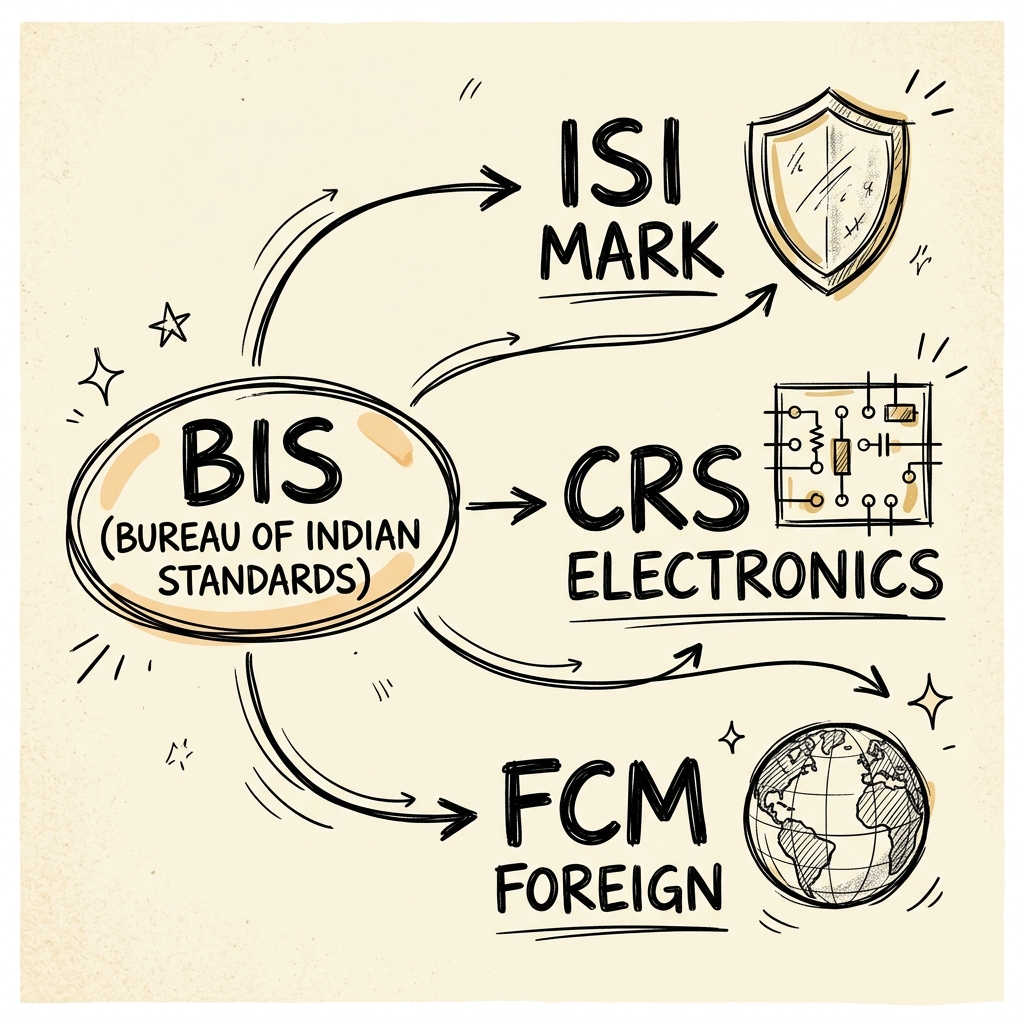
Its logic is different from the ISI Mark scheme:

🧪

No factory inspection

Conformity is demonstrated by a test report from a BIS-recognised laboratory plus the manufacturer's self-declaration of conformity.

📜

Registration, not licence

You receive a Registration Certificate carrying a unique number in the format R-XXXXXXXX (the "R-number").

🏷️

Model-specific certificate

Registration is granted per product, per brand, per manufacturing location, per listed models.

🌐

Applies to foreign makers equally

A Chinese, Korean, Vietnamese or American manufacturer registers on the same portal, through an Authorized Indian Representative (AIR).

Once a product is notified under CRS, no person may manufacture, import, store for sale or sell it in India without registration — enforcement happens at customs, through market surveillance, and via marketplace delisting (Amazon and Flipkart require the R-number at listing).

Notified Categories

Which Products Need CRS Registration?

CRS applies only to products specifically notified by the government — having an Indian Standard alone does not trigger CRS. The notified list spans roughly 80+ product categories and keeps growing. Major categories include:

CategoryExamples of Covered Products
💻Mobile & computingMobile phones, laptops, tablets, notebooks, smartwatches
🔋Power & chargingPower banks, adapters/chargers for IT & AV equipment, USB-driven devices
💡LightingLED lamps, self-ballasted LED lamps, LED luminaires, LED modules
📺Audio/videoTelevisions, set-top boxes, speakers, Bluetooth speakers, CCTV cameras & recorders
🔌Home & kitchen electronicsMicrowave ovens, induction hobs, electric irons, rice cookers, air fryers (per current notifications)
🖨️IT peripheralsPrinters, scanners, keyboards, mice, monitors, servers, POS terminals
⚡Energy & storageUPS/inverters (≤ specified ratings), sealed secondary cells/batteries, solar products (selected)
📦Others notifiedWater dispensers, smart card readers, barcode scanners, cash registers, amplifiers & more
Check Current Mandatory Notification Status

The list above is indicative — always verify notification status for your exact model. InteLegal confirms applicability within one working day — free.

Free Product Applicability Check →
Legal Ownership

Who Must Apply — Manufacturer, Importer, or Brand Owner?

This is the most misunderstood part of CRS, so let's be precise:

The registration is always in the manufacturer's name
Never the importer, trader or distributor. An importer can legally import only if the manufacturer holds valid CRS registration for that product/brand/models.
Indian manufacturers apply directly
Domestic manufacturing facilities file directly on the crsbis.in portal under their legal business name and factory address.
Foreign manufacturers must appoint an AIR
Foreign manufacturers without an Indian liaison/branch office must appoint an Authorized Indian Representative (AIR) who files and manages the application.
Brand owners & OEM/ODM arrangements
If you sell under your own brand but contract out manufacturing (OEM/ODM), the factory registers — but your brand can only be covered with a brand authorization letter, and each brand needs its own application unless the same entity owns both brands.
Each factory location = separate registration
Even for the identical product and brand, manufacturing unit A and manufacturing unit B require independent CRS registrations.
E-commerce sellers & Importers responsibility
Your job is to verify the factory's R-number covers your exact brand and models before listing — "my supplier has BIS" fails when the brand or model isn't on the certificate.
Step-by-Step Flow

CRS Registration Process — Step by Step (2026)

The entire process runs on the official CRS portal (crsbis.in):

01

Confirm applicability & Indian Standard

Match your exact product to the current CRS notification and its IS code (e.g., IS 13252 for IT/AV equipment safety, IS 10322 for lighting). Wrong IS code = rejected application, fees lost.

02

Create the portal account

Manufacturer details, factory address, contact; foreign manufacturers add Authorized Indian Representative (AIR) details at this stage.

03

Generate a test request

Select a BIS-recognised laboratory on the portal; the system generates a QR code for sample tracking.

04

Send samples with QR code affixed

Labs test against every parameter of the applicable Indian Standard; BIS has directed empanelled labs to issue reports within 30 days of sample receipt.

05

Verify the test report

It must be not more than 90 days old at the time of application, and manufacturer name, factory address, brand and model numbers must match your documents exactly.

06

File the online application

Upload all documents (Form I application, Form II undertaking, Form III affidavit; Form IV AIR nomination for foreign manufacturers) and pay the government fees.

07

Courier hard copies (Foreign makers)

Courier hard copies of the application set to BIS within 15 days of online submission.

08

BIS scrutiny & queries

Respond to any portal query within the stipulated time — unanswered queries stall or kill applications.

09

Grant of Registration

Certificate issued with unique R-number (R-XXXXXXXX), brand, models, IS standard and validity.

10

Mark the product

Standard Mark + R-number + IS number on the product and/or packaging, per the marking requirements of the applicable order.

11

Maintain & renew

Track validity (2 years initially), apply for renewal ≥90 days before expiry, and file inclusions when you add models.
BIS CRS Registration Workflow Diagram
Required Documents

Documents Required for BIS CRS Registration

#DocumentNotes / common errors
1Manufacturing unit address proofGovernment-issued document showing the factory address and manufacturing activity; utility bills alone are frequently rejected
2Business/company registrationCertificate of incorporation / factory licence; foreign manufacturers: registration in original language + English translation
3Test report from BIS-recognised lab≤90 days old; details must match application exactly
4Trademark / brand registration certificateIf brand is owned by a third party, add a brand authorization letter
5Authorized signatory ID & authorizationPhoto ID, authorization letter on letterhead
6Product technical documentsSpecification sheet, circuit/block diagrams, user manual, critical components list (CCL) with component conformity marks where applicable
7Product photographsProduct, rating label, packaging, PCB/internal views as applicable
8Rating label & packaging artworkMust show brand, model, IS number, electrical ratings, country of origin and the BIS marking layout
9Form I, Form II, Form IIIForm I (application), Form II (undertaking), Form III (affidavit) — prescribed formats on the CRS portal
10Foreign manufacturers only: Form IV setAIR nomination form, AIR affidavit & undertaking, AIR KYC (ID, address proof), manufacturer–AIR authorization, Class 2/3 Digital Signature in AIR's name
The five errors that cause most rejections: stale test reports (>90 days old), manufacturer name/address mismatch across documents, model numbers on the report not matching the application, incomplete AIR documentation, and unverifiable factory address proof.
Official Fee Schedule

CRS Government Fees (2026)

Per the current CRS fee schedule (crsbis.in):

StageComponentAmount*
New registrationApplication fee₹1,000
New registrationProcessing fee (includes one test report)₹25,000 (Indian manufacturer) / ₹50,000 (foreign manufacturer)
New registrationAdditional test reports₹10,000 per report
New registrationAnnual registration fee × 2 years₹2,000
New registrationIndicative total (Indian, one test report)≈ ₹28,000 + GST
Inclusion (adding models)Inclusion fee₹15,000 (includes one test report) + ₹10,000 per extra report
RenewalApplication + 2-year registration fee + processing≈ ₹28,000 + GST
Miscellaneous servicesEmail update, AIR change, address change, CCL update₹5,000 per service

*Plus GST as applicable and laboratory testing charges (paid to the lab, typically ₹15,000–₹1,00,000+ depending on product complexity). MSME applicants receive a 20% concession on the processing fee. Figures last verified against the CRS portal fee schedule on 03 October 2026 — the current official schedule prevails.

MSME Concession: Registered MSME applicants receive a 20% concession on the portal processing fee.
Lifecycle Management

Validity, Renewal & Model Additions

Initial validity: 2 years
A CRS registration is granted for an initial term of 2 years from the date of issue.
Renewal ≥90 days before expiry
Apply through the portal at least 90 days before expiry; renewed registrations can be granted for 2, 3 or 5 years. Fresh testing is not always required — if the product, critical components, factory and standard are unchanged, renewal can proceed on the previous test reports plus declarations; changes may trigger re-testing.
Late renewal penalties
Late renewal after expiry attracts late fees and creates a compliance gap during which importing or selling is a violation of the BIS Act.
Inclusion (Adding new models)
Adding new models under an existing registration is faster and cheaper (₹15,000 + testing) than a fresh application — provided the models fall under the same IS and product category.
Material Changes must be notified
Changes of brand, factory address, AIR or critical components must be reported and processed through the portal's prescribed services — unreported changes invalidate the registration.
Key Differences

CRS vs ISI Mark — Don't Confuse Them

ParameterCRS (Scheme II)ISI Mark (Scheme I)
ProductsNotified electronics & ITNon-electronics under QCOs (steel, cement, appliances, toys…)
Factory inspectionNoYes
BasisLab testing + self-declarationLab testing + factory inspection + surveillance
What you getRegistration + R-numberLicence + CM/L number
Foreign manufacturersYes, via AIRYes, via FMCS
Validity2 years, renewable1–2 years initially, renewable up to 5

Avoid Scheme Misclassification

Selling electronics with an ISI mark when CRS is required — or vice versa — is treated as non-compliance. If your product sits near a boundary, get the applicability checked professionally.

Check Product Route →
Knowledge Base

Frequently Asked Questions — BIS CRS

Straightforward answers to the most common questions regarding BIS CRS registration, lab testing, R-numbers, and compliance.

1. What is BIS CRS registration?+
CRS (Compulsory Registration Scheme) is BIS Scheme II for notified electronics and IT products. The product is tested at a BIS-recognised Indian laboratory, the manufacturer self-declares conformity, and BIS issues a registration certificate with a unique R-number — without any factory inspection.
2. Is CRS registration mandatory for all electronics?+
No — only for electronics and IT products specifically notified by the government (MeitY and other ministries). The list covers roughly 80+ categories including mobiles, laptops, LED lighting, power banks, adapters, TVs and CCTV, and grows through new notifications. Verify your exact product before assuming.
3. Who applies for CRS — the importer or the manufacturer?+
Always the manufacturer. Importers, traders and brand owners cannot hold CRS registration; they may sell only if the actual manufacturer holds a valid registration covering that brand and those models. Foreign manufacturers apply through an Authorized Indian Representative (AIR).
4. How much does CRS registration cost?+
Government fees are approximately ₹28,000 + GST for an Indian manufacturer with one test report (₹1,000 application + ₹25,000 processing + ₹2,000 two-year registration fee). Foreign manufacturers pay a ₹50,000 processing fee. Laboratory testing charges are separate. MSMEs get a 20% processing-fee concession.
5. How long does CRS registration take?+
Typically 3–6 weeks end-to-end: testing up to 30 days plus BIS scrutiny of the online application. Complete, consistent documents and fast responses to BIS queries are what keep it at the shorter end.
6. How long is a CRS registration valid?+
Two years from grant. Renewal can be filed from 90 days before expiry, for 2, 3 or 5 years. Fresh testing is not always needed for renewal if nothing about the product, components, factory or standard has changed.
7. What is the R-number?+
The R-number (format R-XXXXXXXX) is the unique registration number on a CRS certificate. It must be displayed on the product and/or packaging together with the BIS Standard Mark and the IS number, and it lets anyone verify the registration on the BIS portal.
8. Can one CRS registration cover multiple models?+
Yes — multiple models can be listed under one registration if they fall under the same product category and Indian Standard and are covered by the test reports. Additional test reports attract ₹10,000 each, and models added later go through the inclusion process (₹15,000 + testing).
9. Does each factory need separate CRS registration?+
Yes. CRS registration is location-specific: the same product made at two factories requires two registrations. The same applies per brand — separate brands on the same product need separate applications unless one entity owns both brands.
10. What happens if I sell electronics without CRS registration?+
Selling a notified product without registration violates the applicable order and the BIS Act, 2016: customs can detain consignments, BIS can seize stock and prosecute (fines up to ₹5 lakh or ten times the goods' value, imprisonment up to two years), and marketplaces will delist your products.
11. Do imported samples or demo units need CRS?+
Commercial imports of notified products require valid CRS registration regardless of quantity. Narrow exemptions exist in some orders (e.g., specified R&D or re-export scenarios) — never assume an exemption without reading the exact notification text.
12. Can InteLegal handle CRS registration end-to-end?+
Yes — applicability check, IS-code identification, lab coordination, document preparation, portal filing, query handling, AIR services for foreign manufacturers, marking guidance, and renewals/inclusions. Start with a free applicability assessment.

Get Free BIS CRS Applicability & Quote

Have an electronic or IT product line? Share your model specifications and manufacturing unit details. Our electronics compliance team will verify your applicable Indian Standard (IS), outline testing requirements, and manage your crsbis.in portal registration end-to-end.

Free Indian Standard (IS) code confirmation
BIS empanelled lab test request & QR code management
30-Day test report fast-track coordination
Online portal filing on crsbis.in with query resolution
Authorized Indian Representative (AIR) for foreign factories
Guidance on R-number label placement & artwork approval

Get a Quote for BIS CRS Registration

Technical expert will contact you on WhatsApp with your quote

Your data is 100% confidential. By submitting, you agree to our Terms & Privacy Policy.